

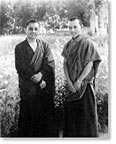
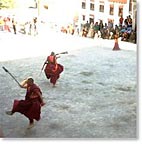
We sat eating fresh apricots - the Rinpoche, his trusted secretary-in-waiting Konchuk Sherab, the monastery's most accomplished mystic, and myself. The Rinpoche called me to his side with a gesture of princely grace and gazed at the monastery courtyard far below the lofty rooms, "It is so quiet now." Only days before, the courtyard pulsed with thirty five dancing monks and ten musicians performing an ancient series of danced rituals lasting the almost unimaginable duration of twenty four hours over two days: thirteen hours of dancing on the first day; eleven hours of dancing on the second.
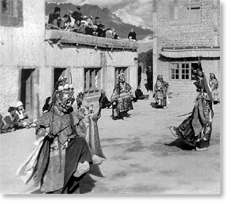 |
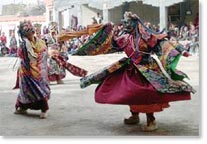
| Dancers in the Cham Ceremony |
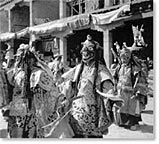
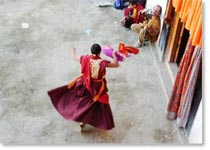
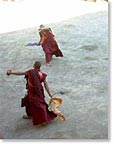
| The dancing itself is difficult to describe because neither its purpose nor its form has any parallel in the West. The twenty-four different dances performed over the two days vary in speed and style. Some are peaceful and fluid; others violent and so fast the monks are unable to slow down or control their bodies' trajectory. Some dances are highly ceremonial and stately; others again depict the wrathful protection of specific deities. In all, the fundamental action is to destroy all obstacles to the purpose of life.
The specific movement vocabulary is limited to approximately 100 movements, or roughly the same as classical ballet, and considerably more than many ancient forms of dance. The combinations of these movements shift and meld like minimalist music, being often so subtle as to escape notice although the timbre of the performance takes on a different quality. Turns and half turns punctuate falling and leaping steps. Fast staccato runs and twisting arms holding a variety of ritual and rhythmic objects pause into sometimes graceful, sometimes grueling backbends. Without notice, the entire ensemble stops for periods that begin again with no perceptible cue.
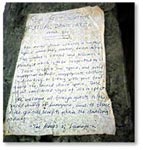
Even the perception of obvious rhythm is often impossible and the uncanny ability of the monks to stay in synchronicity is puzzling. I asked the Rinpoche about this and he answered my questions as well as supplying me with a secret text on the dances. The text is written by the current leader of the Drikung Vajra order, Drikung Kyabgon Chetsang Rinpoche, based upon an early 18th century manuscript detailing the dances from the 13th century onward. Here was the secret toward which the Rinpoche directed me.
Although the musical accompaniment is largely with rhythm instruments, drums and cymbals as well as enormous horns, the musicians play cued by the solo and collective motions of the dancers. The dancers are guided by natural pulsations and the instructions the dancers follow as they execute steps are as such:
Beyond the physical instructions and execution, the dances are intended to be the apotheosis of mystical attainment within the Vajrayana tradition of meditation, which is an elaborate process of forgetting the self, identifying with a particular deity and conceiving the very universe as a mandala in which the deity exists. The dances are cherished for the karmic imprint they leave on both the dancer and the observer. The very core of the dances is to be a representation of the activity of the mind-essence beyond conceptual thinking. The dancers of high accomplishment also utter mantras while they dance and altogether the finest performances express the "Ride like a piece of paper on a crashing wave" "Walk gracefully like a tiger through the forest" "Fly like a Garuda, a mythical bird-beast" "Move the head like a lion shaking a human victim in its mouth" It is the easy community of the monks' living together that affords the spontaneous collective unity and pulse. "three pure bodies" : gestures of hands and feet; uttering of mantras; and holding a meditative state that emanates the nature of bliss. I reminded him of the secret text, which clearly stated the dancer was intended to hold such a state of mind, and also told him I had witnessed such expanded consciousness in Noh performances. He answered immediately, " I don't know what a Noh performance is, but if the dancer can hold a mystical state of mind for a long period time, then the movement must be much slower than our dances." He couldn't have nailed it on the head better: Noh is very slow indeed. I came to realize as well, that these were monks first, not entertainers, and their very lives are lived in a devoted state of mind. To draw a simple parallel: when one performs 15 minutes of Tai Chi with attention to movement, the mind is certainly cleared. Imagine then a 13 hour day of attention to movement in sacred Buddhist dances, and a picture of absorption and transcendence emerges. Performing in masks also internalizes energy before it projects out.
From this account, it would seem all is magical, mystical, profound and transcendent in the world of Himalayan Buddhist dancing, but that is the opposite of the hard reality. Lamaruyu stands alone in the seriousness with which it performs the dances. In Tibet, the dances are banned. In Ladakh, now politically a part of India, the ruthless and ignorant tentacles of "western development" are snaking their way through the region. Leh is the capital of Ladakh, and has become a center for a breed of trekking tourists aware of the region. A cash economy is about 15 years old, and suddenly everyone in and around Leh is desperate to make a buck, wear jeans and drink Coke. The monasteries near Leh are as vulgarly engrossed in this pursuit as anyone else. Local culture is dying. The dances are becoming extinct.
There is no WWF for dance forms, but there ought to be. Today, there remain only three monasteries of the Drikung Vajra order performing intact the great ceremonies of dance. Other orders perform similar dance festivals, but the caliber of dancing varies due to many factors. Among these others, Hemis monastery has led the way in turning the sacred dances into a regional Gilbert and Sullivan entertainment for tourists. It is sickening. The ceremony at Hemis is a tourist nightmare. The dancing isn't well performed, trinket sellers hoard every inch of available space and the tourists' behavior makes one ashamed to be western.
|
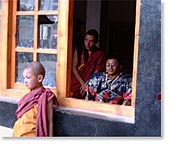
I have struggled to find words to describe the appalling behavior of some the trekking tourists, who are nothing but photo-terrorists. In my many years of travel through forty-two countries, it was the most disgraceful example of tourist behavior I have seen. There was little to do in Ladakh but trek, until eight years ago, when a decision was made to move the dance festivals from winter to summer, "for the tourists" - For the tourists to destroy would be more accurate. Demographically, the trekkers are easy to identify, and I had my own assessment confirmed by the department of tourism in Jammu and Kashmir. Would Americans ( there were only three that entire summer ) be as rude? Who knows? It is safe to say most Americans have never heard of Ladakh.
The philistines do things like invade sacred spaces to get a good photo; bully local villagers, or even step on them, to get the angle they want - things they know they may not do in Europe. In the villagers' eyes, they are too often dressed like harlots and freaks. You cannot take photos during a dance performance in Paris. You cannot click away inside German cathedrals. They know better. Their attitude is imperialist, as if the local culture was just a lark for their leisure. Understanding never enters the picture. Another batch from another country, mostly fresh out of the army, behave as if they are on spring break, boisterous and with no consideration for anyone, local or foreign. The scene at Hemis Monastery is disgusting.
Of the other two Drikung Vajra monasteries, one of them, Shachukhul, is in a politically sensitive region bordering China, and I was not allowed to visit, although the Rinpoche informed me it is a true but simple ceremony between the monks and the villagers; is very remote, hosts few tourists and the monks are working to learn and perform the dances well. This is why he went to help with the performances. Nearer to Leh, Phyang monastery is giving Hemis a run for its money as the most vulgar bastardization of religion in the area. The Abbot of Phyang monastery is the Rinpoche's superior, deeply knowledgeable about the dances having learned them himself in Tibet, and I cannot understand how he can justify the degradation he has allowed to engulf the sacred dances at Phyang.
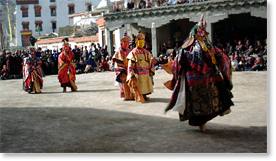 |
Mandalic positioning before an exit |
The monks are as guilty as the tourists for this debasement of religion and culture. They certainly know from Tibet and Sikkim, that indeed Buddhism can be wiped out. They are succeeding where China has failed in Tibet. China would love to keep Buddhism in Tibet as a tourist attraction and dead as a faith. The tourists have no idea what the dances are about and the monks provide no clues. I went to great lengths to find out, and was fortunately befriended by a dancing reincarnate. The monks have wantonly abandoned their mission to teach Buddhism, so perhaps the photo-terrorists and the make-a-buck monks deserve each other. And how rich are the monks becoming? I did a little math. Let's say there are 500 tourists cramming the monastery - a generous figure. Let's say, each one gives 20 rupees, again a generous figure. That comes to 10,000 rupees, or the whopping, life altering sum of about $250. A foundation grant of $300 might convince them to move the ceremonies back to wintertime.
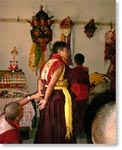 |
| Randgol Nyima being dressed |
" Things have got to change. We have here this beautiful monument defiled by the worst elements of modernity - and , I hate to say, by some pretty unpleasant elements of modern humanity, too."
This brings us back to Lamaruyu. Lamayuru is more remote and difficult to reach than Hemis or Phyang, but it is becoming easier and tourists are increasing. I have suggested to the Rinpoche he ban photography, as has the monastery at Alchi which houses the most extraordinary painting in the region. I went on to offer to produce a printed program informing people of the nature and themes of the dances, and the expected etiquette.
The Rinpoche informed me that among his order, there remain only three old monks, all in their sixties, who know all the steps to the dances. He guesses they have about five more years of performing left. He asked my help in finding a way to document these remaining three monks. The Rinpoche asked if I could make this record within the next three years, because after that, he would be in solitude for three years and unable to oversee the project until he returned. I promised him I would, whether by video, or by high-tech motion capture, a technique used by Merce Cunningham, Bill T Jones, and a host of video games which precisely captures 3-D movement. I am currently involved in a project to motion capture ancient dances from Japan and India and interest to do the same with Peking Opera, Egyptian Raqs Sharqi and VietNamese dance has been passionately expressed.
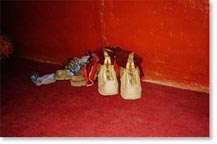 |
The Rinpoche's everyday shoes |
Shortly before I left Lamayuru, The Rinpoche's secretary, Konchuk Sherab pulled me aside and asked, " Joseph, do you believe in Rangdol Nyima Rinpoche?" I thought he was asking if I believed in reincarnation, in esoteric Buddhism, and mystical ecstasy. Sherab continued, " I believe he has the strength and courage to save these dances and promote the truth of Buddhism."
"Yes, Sherab," I answered, " I believe in the Rinpoche too. He is the last chance to save these lost dances of Ladakh. He is a great man, and still young. I believe in him." And then Sherab smiled like an angel.
"Yes, Sherab," I answered, " I believe in the Rinpoche too. He is the last chance to save these lost dances of Ladakh. He is a great man, and still young. I believe in him." And then Sherab smiled like an angel.
